
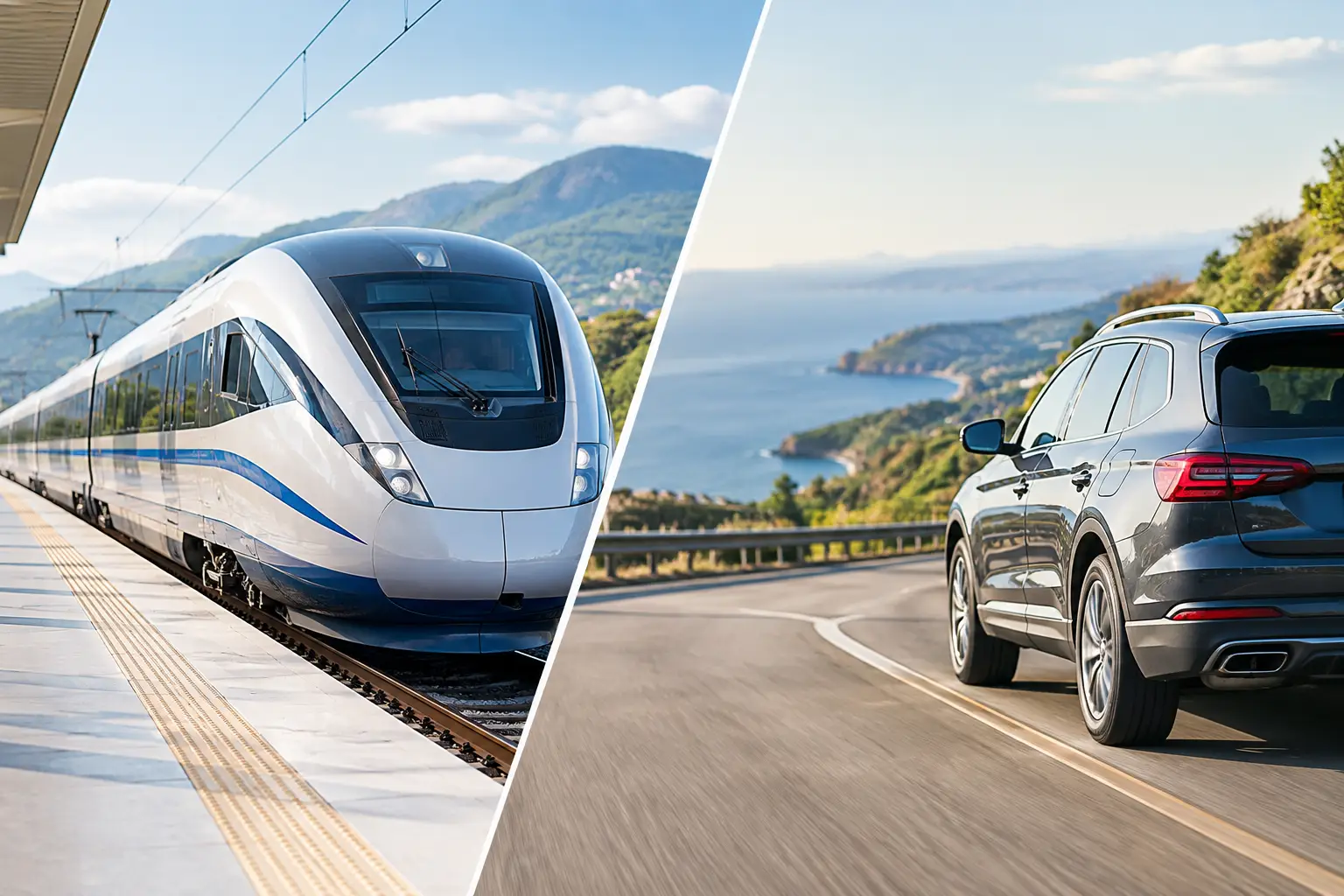
A 09:00 meeting, two cases, a presentation to prepare and rain at the station can make rail versus private car travel feel less like a simple transport choice and more like a decision about how much uncertainty you are willing to accept. Rail is often an excellent option, particularly between major city centres. A private car can be the better choice when the journey needs to work around your timetable, your luggage and your destination rather than the other way round.
The right answer depends on more than the advertised journey time. Door-to-door duration, the number of people travelling, onward connections and the value of arriving composed all matter. For business travellers and visitors with a fixed itinerary, those details are often decisive.
Rail versus private car travel: start with the real journey time
A train timetable shows the station-to-station time. Your actual journey begins when you leave your door and ends when you reach the final address. That may include a taxi to the station, time to find the correct platform, waiting for departure, a transfer at the other end and a final trip to a hotel, office or rural venue.
On a straightforward city-centre journey, rail can be very efficient. Stations are centrally located, services can be frequent, and a passenger can read, work or simply rest on board. If both ends of the trip are a short walk or brief taxi ride from the station, the convenience is difficult to dispute.
Private car travel comes into its own when either end sits outside that rail-friendly corridor. An early meeting on an industrial estate, a country hotel, a golf course, a family address with several bags or an event venue outside the centre can turn a nominally quick rail trip into a sequence of connections. A pre-booked car removes those handovers and follows the schedule you set.
It is also worth allowing for the time that cannot be seen on a route planner. A delayed local connection, wet weather, platform changes and a late-night arrival can each add friction. No mode is entirely immune to disruption, but travelling directly reduces the number of points at which a plan can unravel.
Comfort is about usable time, not just a seat
Rail travel gives many passengers useful uninterrupted time. A table seat, laptop and headphones can make a journey productive, especially if mobile reception and carriage conditions are favourable. For a solo traveller on a mainline route, that can be a compelling advantage.
However, train comfort varies by service and time of day. Peak departures may mean limited luggage space, crowded aisles and no certainty that a group will sit together. A reservation helps, but it does not solve the challenge of getting from the station to a final destination with equipment, garments or multiple cases.
A private car offers privacy and a controlled environment. There is room to make a call discreetly, review notes, travel with colleagues or switch off before an important engagement. For executive travel, the ability to step out at the entrance rather than arrive at a station and arrange the final leg is often more valuable than a few minutes saved on paper.
For longer journeys, vehicle quality matters. Climate control, charging points, Wi-Fi where provided and sufficient luggage capacity are not luxuries when the car is also a temporary workspace. They help travellers arrive ready for what comes next.
Compare costs fairly, not just ticket prices
Rail can look cheaper at first glance, particularly when tickets are booked well in advance. Advance fares can offer strong value for one person with light luggage travelling between well-served stations. Flexibility usually costs more, though, and walk-up fares can be considerably higher when plans change.
Private car pricing should be assessed as a total journey cost. Consider station taxis at both ends, public transport for colleagues travelling separately, parking, luggage handling and the potential cost of a missed connection. For two, three or four passengers travelling together, the difference can narrow quickly.
There are two distinct private-car options. Driving yourself may appear economical, but fuel, parking, congestion, fatigue and the need to leave a vehicle somewhere all deserve a place in the calculation. A professionally driven car costs more than self-driving, yet it removes the responsibility of the road and allows every passenger to use the time differently.
For corporate travel, transparent pre-booked pricing can also make expense planning simpler. The aim is not to claim that a private car is always the lower-cost option. It is to compare like with like: the full cost of reaching the destination on time, comfortably and without avoidable complications.
Luggage, equipment and groups change the equation
Rail works best when you can carry what you need easily. One case and a laptop bag are manageable. Add golf clubs, product samples, several suitcases, a pushchair or formalwear for an event, and the experience becomes more demanding.
A private car allows luggage to travel with you from collection point to destination. That is particularly useful for visitors who do not know a city well, groups arriving with different-sized bags, or travellers continuing to a location with limited public transport. It also avoids the risk of finding a busy train carriage with little space left for larger items.
Groups should look beyond the fare per passenger. A train may be the obvious choice for a couple travelling light on a direct route. For a family, visiting team or small group headed to one address, a single vehicle provides a shared departure, shared arrival and no need to coordinate separate transfers. The journey itself can become part of the day rather than a logistical exercise.
Reliability means having a workable contingency
Trains operate to published schedules, and many journeys run exactly as expected. Yet services are exposed to weather, industrial action, infrastructure issues and network congestion. If a particular arrival time is non-negotiable, it is sensible to check the service status and leave a realistic margin.
Road travel has its own variables: traffic, roadworks and weather can affect timings. The advantage of a professional pre-booked journey is active planning. An experienced driver can allow for conditions, choose an appropriate route and make sensible adjustments when circumstances change. You are not dependent on the final bus, taxi rank or a connecting train being available at the right moment.
This distinction matters most for time-sensitive occasions. A rail journey may be ideal when an hour's delay is inconvenient but manageable. A private car is often the more prudent choice when missing a flight, a client meeting, a dinner reservation or a tee time would affect the whole day.
When rail is the better option
Choose rail when the route is direct, both locations are close to stations and you are travelling alone or with minimal luggage. It is especially practical when you want dedicated time to work and your schedule has enough flexibility to absorb a minor delay.
Rail can also be the more relaxed choice for leisure travellers who enjoy the journey itself and have no need to make intermediate stops. Booking ahead, reserving seats and checking planned engineering works will improve the experience considerably.
When a private car is worth choosing
A private car is generally the stronger option when you need door-to-door travel, are carrying substantial luggage, travelling as a group or visiting a destination beyond the main rail network. It is also well suited to early departures, late arrivals and days involving more than one stop.
For a meeting or occasion where presentation matters, the value lies in control. You know where you will be collected, who is responsible for the journey and how you will reach the door. AlbaGo provides this type of pre-booked, professionally driven travel for passengers who would rather spend their journey preparing, resting or simply travelling with confidence.
The best choice is the one that protects the purpose of your trip. If rail gives you a direct, comfortable route with sufficient margin, it may be exactly right. If the itinerary has little room for connections, uncertainty or carrying bags across a city, arranging a private car can turn a complicated travel day into a straightforward one.
Ready to book your journey?
Private chauffeur transfers and Highland tours from Edinburgh, booked online in minutes.
Book Online Instantly