
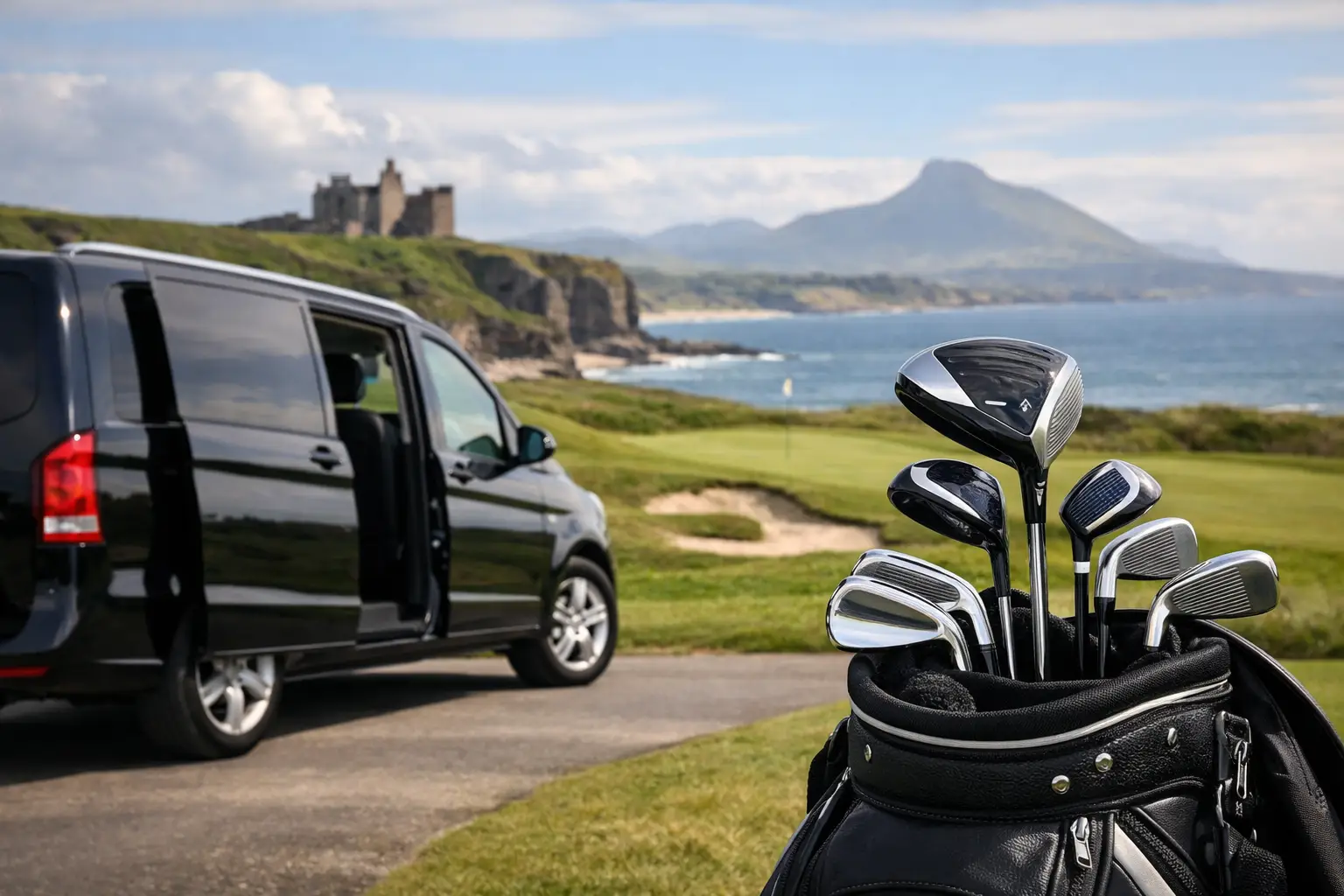
A 7.30am tee time at a course an hour from your hotel leaves little room for a missed pickup, a cramped boot or a driver unfamiliar with the route. The best top Scotland golf transfers are not simply about getting from A to B. They are about protecting the pace, comfort and enjoyment of a golf itinerary that may have taken months to arrange.
For visitors playing several courses, transport is often the detail that determines whether the day starts relaxed or rushed. A well-planned private transfer gives the group room for clubs and luggage, a clear collection time and enough flexibility for changing weather, a slow round or a post-golf lunch.
What Top Scotland Golf Transfers Should Deliver
A golf transfer should be planned around the whole day, not just the journey to the first tee. That means the vehicle needs appropriate luggage capacity, the driver needs the collection and return arrangements confirmed in advance, and the schedule must account for the realities of Scottish golf travel.
Many leading courses sit outside major city centres, on coastal roads or in rural locations where public transport connections are limited. A train or local taxi can work for a simple, one-course plan, but it becomes less attractive when four players, four golf bags, holdalls and a tight tee time are involved.
A premium private hire service is particularly valuable where the itinerary includes early starts, multiple stops or a different collection point at the end of the day. It replaces a chain of separate arrangements with one accountable journey plan.
Start With the Itinerary, Not the Vehicle
It is tempting to choose a vehicle first and work backwards. The better approach is to establish where the group is sleeping, playing and dining, then select transport that fits the route and party size.
Allow proper time before a tee time
Aim to arrive at least 45 minutes before the scheduled tee time, and longer if the group needs to check in, use the practice facilities or visit the professional's shop. This buffer matters more at unfamiliar clubs, particularly where the clubhouse, bag drop and first tee are spread across the site.
The journey estimate should also include time to load clubs. Golf bags are awkward rather than especially heavy, and loading four of them neatly takes longer than placing a few suitcases in a boot. For early rounds, confirm the pickup time the day before rather than relying on an assumed schedule.
Plan for the round to run long
An 18-hole round can vary considerably according to course layout, weather and how busy the tee sheet is. A fourball on a championship links may take longer than expected, especially in high season. Booking a rigid return collection immediately after the theoretical finish time can create unnecessary pressure.
A good arrangement provides a realistic collection window or a straightforward way to communicate if the round is running late. If lunch, drinks or a visit to the clubhouse is part of the plan, say so from the outset. It allows the transport schedule to reflect the day guests actually want, rather than the shortest possible version of it.
Choose a Vehicle With Clubs in Mind
The right vehicle depends on the number of passengers, the number of bags and whether it is a transfer day or a full-day itinerary. Two travellers with two golf bags may travel comfortably in an executive saloon. Four golfers with clubs, waterproofs and overnight luggage will usually need a larger executive people carrier or similar spacious vehicle.
Do not assume the stated passenger capacity tells the full story. A vehicle may legally seat six or seven people, yet that does not guarantee sufficient room for a corresponding number of golf bags. Ask for the provider's recommendation based on the exact party size and luggage list.
Golfers travelling in autumn or winter should be especially realistic about luggage. Waterproof outerwear, spare shoes and layered clothing take up more space than a summer weekend bag. The benefit of a slightly larger vehicle is not extravagance. It is being able to travel without bags on seats or clubs crammed in at an awkward angle.
Comfort matters on longer drives as well. After walking 18 holes in wind or rain, a quiet, clean vehicle with room to stretch out makes a material difference. Features such as charging points and onboard Wi-Fi are useful for checking dinner reservations, reviewing the next day's tee time or simply catching up with work between courses.
Understand What Is Included in the Price
A low headline quote can be misleading if it is based on a direct journey with no waiting time, route changes or additional stops. Before confirming, establish whether the price covers the complete requirement: collections, drop-offs, planned waiting, parking charges where applicable and any extended hours.
Fixed, transparent pricing is often the most practical option for golf groups because it makes the travel budget easier to manage. It also avoids an awkward conversation at the end of the day if the round overran or the group chose to stop for a meal.
Be clear about the difference between a point-to-point transfer and a vehicle retained for the day. A transfer is suitable when the plan is simple: hotel to course, then course to hotel. Retained transport is better when the group wants to visit a practice range, stop for lunch, see a local attraction or move between several locations without arranging a new pickup each time.
Neither is automatically better. The appropriate choice depends on how structured the day is and how much independence the group wants between rounds.
Questions to Settle Before Booking Golf Transport
A short, detailed enquiry produces a better plan than a vague request for a car to the course. Include the information that changes the journey most:
- the number of passengers, golf bags, suitcases and any folding trolleys;
- every collection and drop-off address, including hotels outside city centres;
- tee times, preferred arrival times and expected finish times;
- whether the group needs return transport, waiting time or a vehicle available throughout the day; and
- flight details if the golf transfer follows an arrival, plus a contact number for the lead passenger.
It is also worth mentioning mobility requirements, child seats or any guests who may need additional assistance getting in and out of the vehicle. A professional operator can prepare properly when these details are shared in advance. Leaving them until collection day is where avoidable problems begin.
Consider the Route Between Courses
Scotland's golf regions are rewarding precisely because many courses feel removed from busy towns. That appeal can also mean longer drives, narrow roads and fewer convenient places to stop. A route that appears short on a map may take longer in poor weather, during summer traffic or when travelling through a village.
Avoid scheduling back-to-back courses with only the estimated driving time between them. Build in time for breakfast, checking out, loading bags and the occasional unplanned delay. This is particularly relevant when changing hotels after a morning round or travelling from a city base to a coastal course.
For multi-day trips, grouping courses by area is usually more sensible than crossing the country repeatedly. It reduces time in the vehicle and gives the group more space to enjoy each destination. Ambitious itineraries can work, but they should be honest about mileage. Playing a famous course is less enjoyable when every morning begins with a rushed departure.
When Private Golf Transfers Are Not Necessary
Private transport is not essential for every golfing visit. A solo traveller staying near one course may find walking, a hotel shuttle or a local taxi entirely adequate. Rail can also be a good option where accommodation and golf plans align closely with station locations.
The case for pre-booked transport becomes stronger when reliability is non-negotiable: early tee times, several passengers, expensive equipment, rural venues, long distances or a tightly arranged holiday. It is also a more comfortable choice for guests who want to enjoy a drink after the round without appointing a driver or monitoring the clock.
Make the Journey Part of the Day
Golf travel should not feel like a logistical exercise squeezed around the round itself. With the right timings, vehicle and driver arrangement, the journey becomes the calm interval between hotel, course and evening plans.
Give the transport plan the same attention as tee times and accommodation. That small piece of preparation lets the group arrive composed, travel comfortably and keep its focus where it belongs: on the next shot.
Ready to book your journey?
Private chauffeur transfers and Highland tours from Edinburgh, booked online in minutes.
Book Online Instantly