
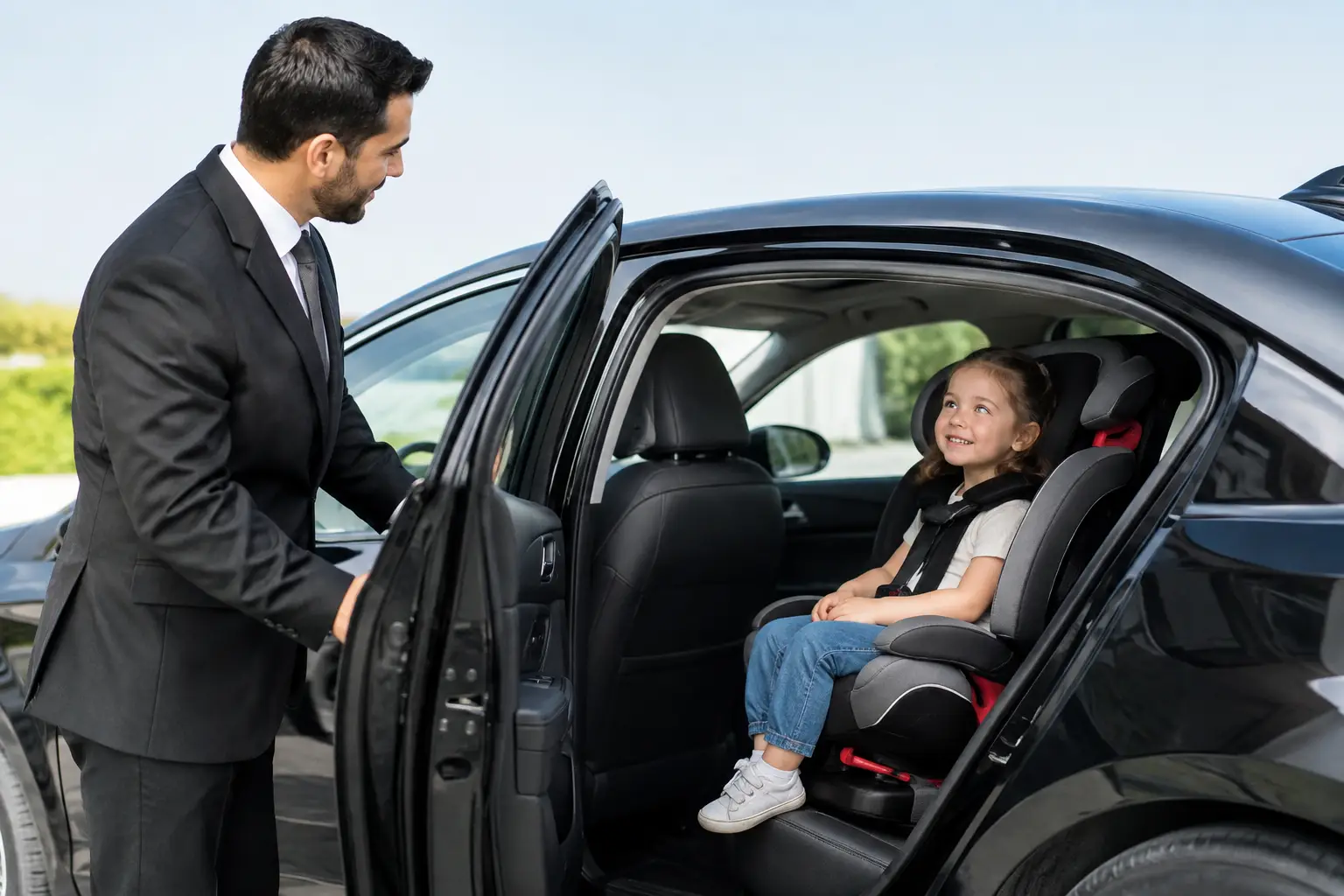
A 5am collection with a tired toddler, two suitcases and a flight to catch is not the moment to discover that a vehicle cannot carry your child safely. Are child seats available with private hire? Often, yes, but availability is never something to assume. It depends on the operator, the child’s age and size, the type of seat required and whether the request was made early enough.
For families, a pre-booked journey should feel organised before the car arrives. The right questions at the booking stage protect both your schedule and your child’s comfort.
Are Child Seats Available With Private Hire?
Many private hire operators can provide child seats when requested in advance. However, there is no universal arrangement across the industry. Some providers hold a limited selection of booster seats or child seats, while others ask parents or guardians to bring their own. Premium providers may be better placed to accommodate a detailed request, but confirmation still matters.
A suitable seat is not simply a matter of selecting small, medium or large. A newborn needs a rear-facing infant carrier, while an older child may need a high-backed booster that positions the vehicle’s seat belt correctly. A seat that is available but not appropriate for your child is not a satisfactory solution.
For this reason, make the request at the same time as the journey booking. A late change can be difficult to accommodate, particularly during busy travel periods, early-morning collections or long-distance journeys where vehicle allocation is planned in advance.
What UK Child Seat Rules Mean for Private Hire Travel
UK law generally requires children to use a suitable child car seat until they are 12 years old or 135cm tall, whichever comes first. The seat must be appropriate for the child’s height and weight, and fitted according to the manufacturer’s instructions.
There are limited exemptions for taxis and private hire vehicles. For example, a child under three may travel without a child seat only in the rear when the correct seat is unavailable. Children aged three or over may use an adult seat belt in the rear of a taxi or private hire vehicle if a suitable child seat is not available.
These exemptions are a legal minimum, not a preferred family travel plan. They should not be treated as a reason to travel without suitable restraint when it can reasonably be arranged. A correctly fitted child seat offers substantially better protection, especially on unfamiliar roads, longer journeys and motorway travel.
The front passenger seat requires particular care. Rear-facing seats must never be used in front of an active airbag. If you are travelling with an infant, the rear seat is normally the most straightforward and appropriate position.
What to Tell the Operator When Booking
A clear request helps the transport provider assign the correct vehicle and prepare the right equipment. Give each child’s age, approximate weight and height, rather than saying only that you need a child seat. This is especially important where siblings need different restraints.
Also explain whether you require a rear-facing carrier, forward-facing seat, high-backed booster or booster cushion. If you are unsure, provide the child’s details and ask what type of restraint can be supplied. A professional operator should be clear about what is available rather than making a vague promise.
It is also sensible to mention the number of passengers and amount of luggage. A family of four with a pushchair, travel cot and large cases may need more space than a standard saloon provides. The vehicle must have room for the required seats without compromising passenger comfort or luggage capacity.
If your plans include multiple stops, a return collection or a journey after an event, include that information too. The same child seats may need to remain with the vehicle throughout the booking, which can affect vehicle planning.
Confirm the Details Before You Travel
Do not rely solely on a note in an online booking form. Ask for written confirmation that the requested child seat or seats can be supplied for your collection. The confirmation should make clear how many seats are being provided and the type agreed.
It is reasonable to ask whether the seat will be fitted before arrival and whether the driver can check the installation with you. The final fit must always follow the seat manufacturer’s guidance, particularly where a seat uses ISOFIX points, a vehicle belt or a top tether. Not every child seat works in every vehicle configuration.
You may also want to ask about the age and condition of the equipment. A reputable provider should use clean, well-maintained seats with clear labels and instructions, and should not supply a visibly damaged or incomplete restraint. If anything appears unsuitable on arrival, raise the concern before the vehicle sets off.
Bringing Your Own Child Seat
Some parents prefer to bring their own seat, particularly for babies or children with specific fitting needs. This gives you familiarity with the product and reassurance that it matches your child’s size. It can also be the practical choice if you are travelling onward in a hire car, with relatives or by another form of transport.
The trade-off is logistics. You will need to carry the seat through the airport or store it at your destination, and it may be awkward alongside pushchairs and hand luggage. If you intend to use your own seat, tell the operator in advance so they can provide a suitable vehicle and allow time for fitting it correctly.
Check whether your seat is designed to be installed with a three-point seat belt if you do not know whether the vehicle will have compatible ISOFIX fittings. Bringing an ISOFIX-only base without confirming compatibility can create an avoidable problem at collection time.
A Quick Check Before Departure
Allow a few extra minutes before setting off, especially with infants. Check that the harness sits correctly, the belt path is right and the seat does not move excessively. Remove bulky coats before fastening a child into a harness, as thick clothing can prevent it from sitting close enough to the body.
For older children in boosters, ensure the lap belt sits low across the hips and the shoulder belt crosses the centre of the chest, not the neck or face. A child who has slipped out of position may need a break or adjustment during a longer journey.
It is worth keeping essentials within reach rather than packed beneath luggage. Water, wipes, a light snack, a comfort item and any medication can make a substantial difference when traffic is slow or a journey takes longer than expected.
Common Questions From Parents
Is there usually an extra charge for a child seat?
Policies differ. Some operators include a seat when pre-booked, while others charge for provision or fitting. Ask about the full price when confirming the journey so there are no surprises.
Can a driver hold a baby during the journey?
No. A child should never travel on an adult’s lap in a moving vehicle. Even at low speed, an adult cannot safely restrain a child during sudden braking or a collision.
Can I request more than one child seat?
Yes, but this must be specified in advance. Multiple seats can affect vehicle choice, seating positions and luggage space. Booking early gives the operator the best chance of meeting the request properly.
What if a suitable seat cannot be provided?
The safest option is usually to bring your own approved seat or choose a provider that confirms suitable equipment in writing. Do not leave this decision until the vehicle arrives, particularly when travelling with a baby or on a longer route.
A dependable family journey begins with a specific request, not an assumption. Confirm the right restraint, the right vehicle and the space you need before departure, then you can focus on the journey ahead rather than solving a safety issue at the kerbside.
Ready to book your journey?
Private chauffeur transfers and Highland tours from Edinburgh, booked online in minutes.
Book Online Instantly