
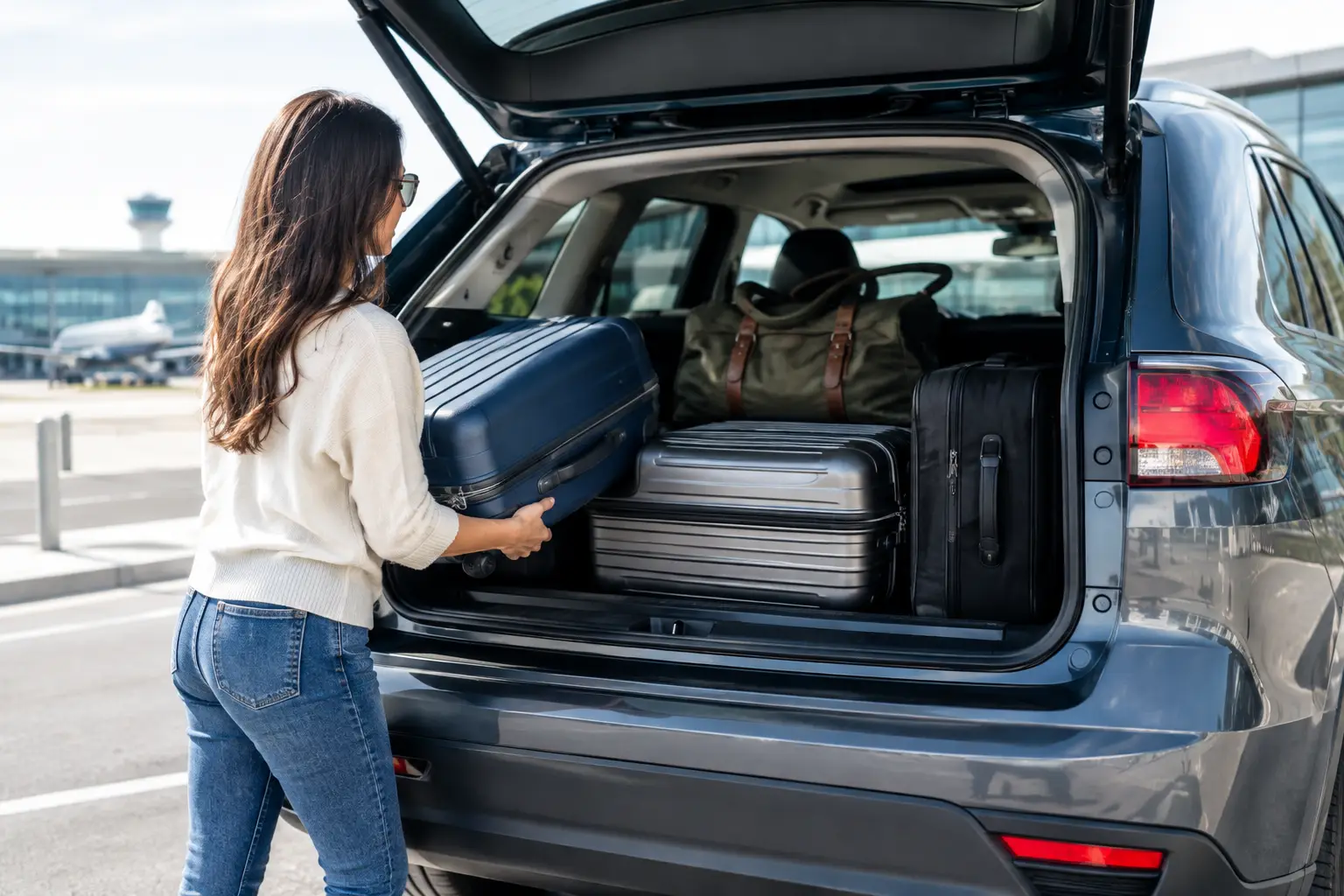
A luggage allowance can look generous on an airline booking, yet luggage limits become far more practical once four passengers, cabin bags, a pushchair or golf clubs need to fit into one car. The issue is not simply whether the boot closes. It is whether everyone can travel safely, comfortably and without a last-minute vehicle change.
For business travellers, families and visitors carrying equipment, confirming luggage requirements before transport is arranged is one of the simplest ways to protect a punctual departure. It avoids cramped seating, unsecured bags and the uncertainty of trying to make everything fit at the kerb.
Luggage limits are not one rule
There are usually two separate limits to consider: the airline's baggage policy and the capacity of the vehicle taking you to or from the airport. They are related, but they are not interchangeable.
An airline may permit a checked case weighing 23kg, a cabin bag and a personal item per passenger. That tells you what may be accepted at check-in. It does not tell you how much boot space is needed to transport those items together.
Vehicle capacity depends on the number, shape and size of cases, not only their weight. Two soft holdalls can often be positioned around other luggage. Two large rigid cases may take up most of a saloon boot. A compact cabin case is easy to carry but, with several passengers, can still matter when every available space is needed.
This is why a transport provider should be given an accurate picture of both passenger and baggage numbers. “Four people with luggage” is useful as a starting point, but it is not always enough information to select the right vehicle.
Start with the bags, not the passenger count
A vehicle that seats four passengers does not automatically carry four large suitcases. Seating capacity and luggage capacity are separate practical limits.
When planning a journey, count each item that must travel in the vehicle. Include checked cases, cabin cases, rucksacks, garment bags, laptop bags, duty-free purchases, children’s items and any specialist equipment. A handbag or slim laptop case may be comfortably kept with the passenger, but it should still be mentioned if the party is already travelling with several cases.
The most useful description includes the type of baggage. For example, “two large hard-shell cases, two cabin cases and two laptop bags” gives a far clearer indication than “six bags”. It also allows the vehicle to be allocated on the basis of real space, rather than an assumption.
Large cases change the calculation
Large checked luggage is the most common reason a seemingly suitable vehicle proves too small. Modern hard-shell cases are often deeper and less flexible than fabric luggage, particularly when fully packed. Their wheels, handles and square edges can prevent efficient stacking.
As a guide, a couple travelling with two medium cases and two cabin bags may be well suited to an executive saloon. Add another two adults, or replace medium cases with large ones, and an executive estate or people carrier may be the more sensible choice. The correct answer depends on the actual cases, but the principle is consistent: leave room for the luggage you know you have, not the luggage you hope will fit.
Specialist items need specific confirmation
Some items should never be treated as ordinary baggage. Golf bags, skis, folding wheelchairs, prams, musical instruments and presentation materials can require a larger vehicle even when there are only one or two passengers.
Golf clubs are a good example. A standard bag is long, shaped awkwardly and not easily stacked. Two golf bags, several suitcases and a full passenger complement may call for a vehicle with substantially more luggage room than a standard car. The same applies to travelling with a child: a buggy, car seat and changing bag can use meaningful space before the family’s cases are loaded.
If an item has unusual dimensions, provide them where possible. A few extra details before collection are much better than discovering the restriction at the point of departure.
Airline baggage rules still matter
Although the car needs its own capacity check, airline limits remain central to the plan. They can affect how many bags are being brought to the vehicle, how heavy they are and whether extra pieces are added at the last moment.
Airlines differ by ticket type, route and loyalty status. One fare may include a cabin bag only; another may include a checked case. Some carriers impose strict cabin-bag measurements, while others are more focused on weight. Travellers should check the allowance on the specific booking rather than relying on what was included on a previous flight.
It is also worth checking the permitted size of cabin baggage, not just its weight. A case that is acceptable for one airline may need to be checked on another. If that happens, the journey begins with more hold luggage than originally planned.
For international travel, leave a margin rather than packing to the exact allowance. A full case can become heavier after gifts, conference materials or shopping are added. Repacking a case at check-in is inconvenient, particularly when travelling for a meeting or working to a tight schedule.
Choose comfort and safety over a tight fit
The temptation to make everything fit is understandable, especially when the party is only one bag over an initial estimate. Yet bags should not be piled on laps, placed where they interfere with doors or left loose in the passenger area.
A loaded vehicle must still allow every traveller to sit correctly with a seat belt fastened. The driver's visibility and ability to operate the vehicle must not be affected. In the event of sudden braking, unsecured luggage can become hazardous.
There is also a comfort consideration. An executive journey should offer space to prepare for a meeting, make a call or simply relax before a flight. If cabin cases have to occupy footwells and seats, the vehicle may technically be moving, but it is not providing the calm, well-managed experience most travellers expect.
For this reason, a larger vehicle is often a practical upgrade rather than an unnecessary luxury. It gives the driver space to load bags securely and gives passengers room to travel without compromise. On longer journeys, that difference is especially noticeable.
How to give an accurate luggage brief
A short, clear booking note can prevent most capacity problems. State the number of adults and children, then list the bags by type and size. Mention bulky or fragile items separately, and say whether a child seat, pushchair or wheelchair is required.
If your plans are still changing, provide the best estimate at booking and update the transport provider as soon as the final baggage count is known. This is particularly valuable for group travel, where one additional suitcase per person can quickly alter the vehicle requirement.
It is sensible to think about the return trip too. A journey from the airport may involve more luggage than the outbound trip after shopping, event materials or golf equipment hire. Booking the same vehicle both ways can be convenient, but only if it remains suitable for the return load.
A practical check before collection
The evening before travel, place all luggage together and count it again. This final check catches the items that are easily overlooked: coats in garment carriers, extra work bags, children’s travel accessories and items collected during the stay.
If the total has changed, advise the provider promptly. A professional transport service can assess whether the original vehicle remains appropriate or whether more capacity is needed. Early notice creates options; a surprise at collection creates pressure.
When more space is the better decision
Travellers often focus on keeping the number of vehicles low, but a single vehicle is not always the best arrangement. For a larger group with full-size luggage, two suitably sized cars may be safer and more comfortable than trying to use every seat and every inch of boot space in one vehicle.
This can also be useful where passengers have different collection points or flight times. It depends on the itinerary, luggage volume and preference for travelling together, but it is worth considering when the margins are tight.
For corporate travel, it is equally sensible to separate people from equipment where necessary. A team carrying exhibition materials, sample cases or technical equipment should not have to choose between safe loading and a comfortable journey. Clear planning reflects well on the organiser and keeps the schedule protected.
Luggage limits are easiest to manage when they are treated as part of the journey, not an afterthought. Give an honest account of every bag, allow some spare capacity, and choose a vehicle that lets the driver load securely. The result is simple: passengers can step out at the terminal composed, organised and ready for what comes next.
Ready to book your journey?
Private chauffeur transfers and Highland tours from Edinburgh, booked online in minutes.
Book Online Instantly